
Services / 3D Bio Printing & Ai
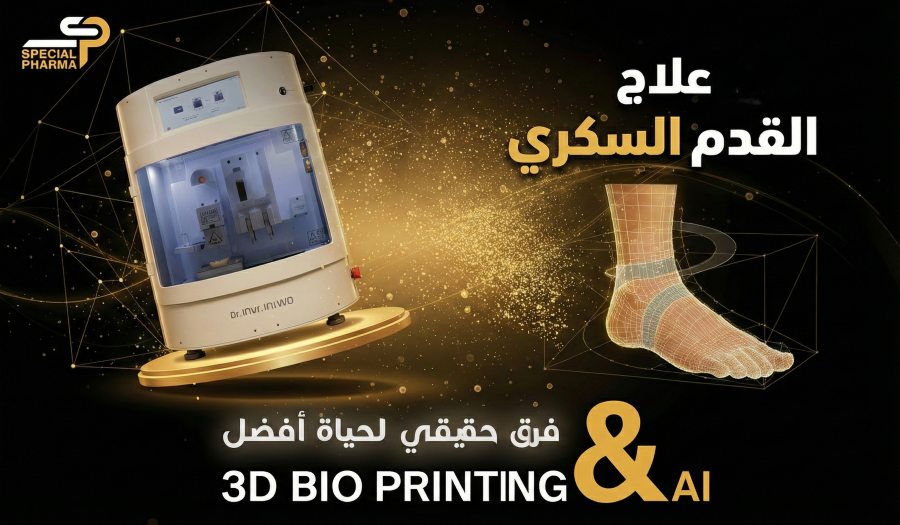
We provide a next-generation treatment for diabetic foot ulcers through internationally certified 3D bioprinting technology. This innovative approach rebuilds skin layers using the patient’s own cells, ensuring safe, rapid healing with no immune rejection and minimal clinical visits.
3D bioprinting represents a major revolution in chronic wound management. By combining high-precision wound scanning, artificial intelligence analysis, and personalized bio-ink preparation, the technology reconstructs damaged skin directly on the affected area.
This method has been validated in global clinical studies across the USA, Korea, India, Turkey, and Malaysia—showing significantly higher healing rates compared to conventional treatments. At Special Pharma, we aim to introduce and expand this technology in Egypt to support national healthcare goals and improve the quality of life for diabetic patients.
Complete wound healed rate at week 12 shows 87% in ROKIT’s treatment group, compared to 38% in conventional treatment.
All patients in the test group represent acceleration of epithelialization. No adverse events were observed during the study.
It is a regenerative technique that rebuilds skin using layers of bio-ink created from the patient’s own cells, printed directly onto the wound.
The treatment is non-surgical and generally painless. Most patients experience minimal discomfort.
Improvement typically begins within the first few weeks, with complete healing reported within 12 weeks in most clinical cases.
This therapy is suitable for the majority of patients with chronic diabetic foot ulcers. Suitability is determined after assessing circulation, wound type, and overall medical condition.
Partner with us to create intelligent, impactful, and future-ready AI solutions together.

١٠ شارع البطل احمد عبدالعزيز - المهندسين, Giza, Egypt
Copyright © 2025 All Rights Reserved.